
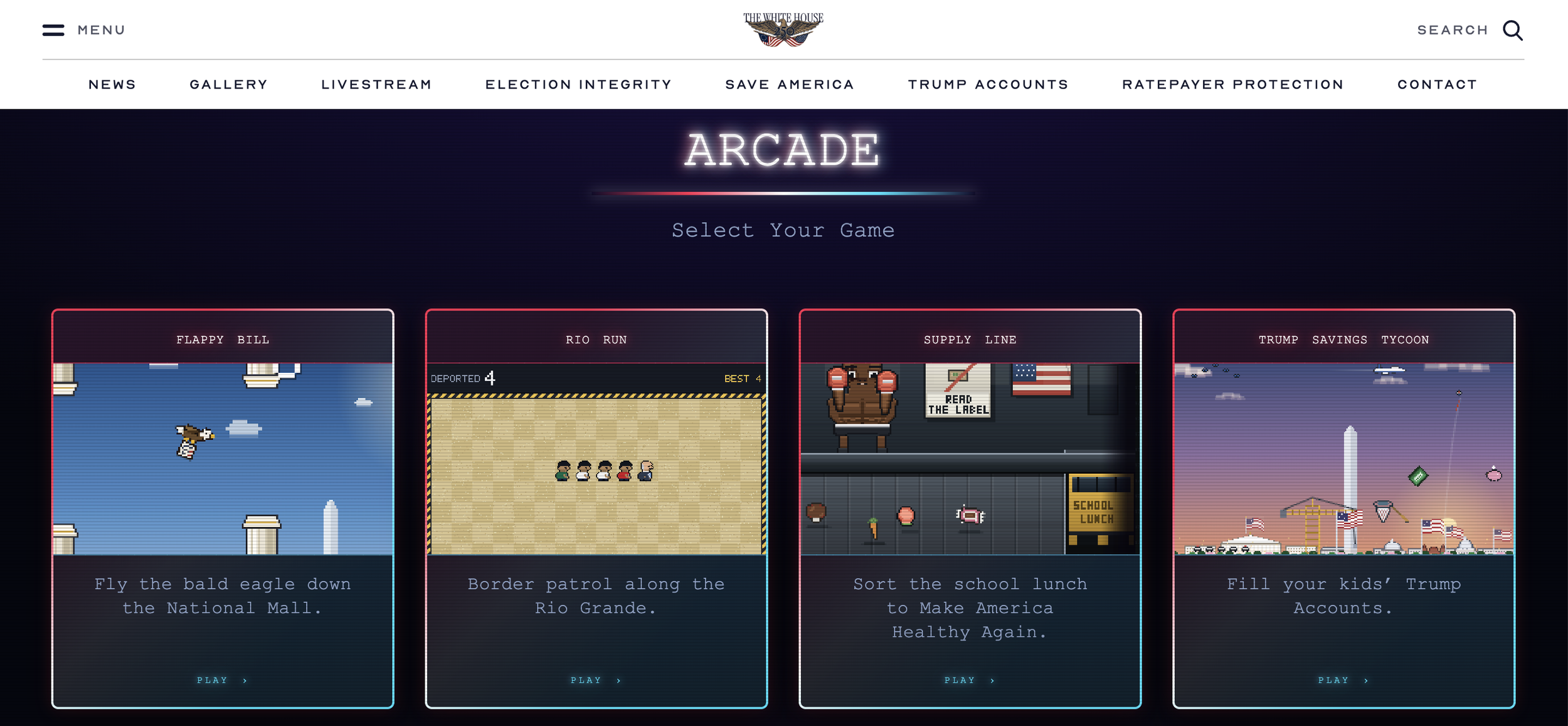
On September 3, 2026, the White House quietly launched a new section of its official website called Arcade — five low-resolution browser games, live right now at whitehouse.gov/arcade and arcade.gov, each one built on the bones of a classic you grew up with. Except this time, the games aren't selling you nostalgia. They're selling you policy. And one of them turns human deportation into a high-score chase. This one made me genuinely ANGRY.
The Games, and Why They're Not Cute
Build the Wall — Tetris, except you're stacking blocks to keep out what the game itself calls "the coming horde."
Rio Run — A Snake clone where you round up border crossers along the Rio Grande. Real people, reduced to sprites you collect.
Supply Line — A Tapper knockoff sorting foods by "Make America Healthy Again" standards.
Flappy Bill — Flappy Bird, but it's an eagle carrying legislation over the National Mall.
Trump Savings Tycoon — Catch falling cash for "Trump Accounts," the administration's savings program.
Let that sink in for a second: a sitting administration built a Snake clone where the win condition is rounding up migrants, dressed them up in orange jumpsuits once "caught," and put it on a federal government website. This isn't satire. This isn't a mod some troll built in their basement. This is the executive branch of the United States government, using tools we associate with childhood arcades, to gamify immigration enforcement.
That should stop you in your tracks. It stopped us.
"Policy You Can Interact With"
That's the actual phrase a White House official used to describe this. Another said the point was to contrast a "culture of fun and winning" with the opposition's "dark socialist vision." Read that again. The federal government is spending time, resources, and web infrastructure to turn deportation and border policy into a dopamine loop, and calling it fun.
It's not surprising this landed like a lead balloon. Critics have rightly called out how dehumanizing it is to gamify deportation. Nintendo is reportedly pursuing legal action over how closely these rip off its IP. Japan has formally objected — twice. And a "Coming Soon" tag on the site says this isn't even done. There's more coming.
And Nobody Will Say Who Paid For It
Here's the part that should make everyone's blood boil, gamer or not: when ABC News directly asked the White House whether any contractors were hired or public money was spent building this thing, they got silence. No answer. No cost breakdown. No vendor name.
What we do know is that this lives on whitehouse.gov and arcade.gov — taxpayer-funded federal infrastructure, full stop. So at minimum, our tax dollars are hosting it. Whether they built it too is a question the administration has simply refused to answer, while gas prices sit roughly 45% above 2020 levels and groceries are up about 30%. People can't afford basic necessities, and the government's response includes launching browser games and stonewalling reporters about what they cost.
This Isn't Normal, and We Shouldn't Act Like It Is
Video games are a medium we love, and it's genuinely infuriating to watch it get co-opted as a messaging tool for the federal government — used to make deportation feel like a leaderboard chase, with zero financial transparency, on the public's dime, on public infrastructure. This isn't "policy you can interact with." It's propaganda with a coin slot, and it deserves way more scrutiny than a cutesy retro-game news cycle.
We'll be watching for whatever's next on that "Coming Soon" banner. And we'll keep asking the funding question until someone in Washington actually answers it.
We're unpacking this one further on the next episode of the Duck N Cover Gaming podcast — catch it on Spotify and Apple Podcasts.
